Advertisement
Could Narendra Modi’s ‘Gujarat model’ be to blame for the Indian state’s high coronavirus toll?
- Modi was Gujarat’s chief minister for 13 years and cited his model for economic growth and job creation as a reason to elect him prime minister
- But spending on health declined and the state now has India’s highest Covid-19 case-mortality ratio as it battles to cope with poor infrastructure and resources
Reading Time:3 minutes
Why you can trust SCMP

As India reported a record daily increase in coronavirus infections and deaths on Tuesday, with more than 266,000 cases and 7,466 fatalities, the spotlight has also turned to the high mortality rate in Prime Minister Narendra Modi's home state of Gujarat.
With 1,280 deaths as of Monday, Gujarat has recorded the second-highest number of deaths among Indian states, and a case-mortality ratio of 6.22 – more than double the nationwide figure.
Modi, 69, ruled Gujarat for 13 years, citing the “Gujarat model” of economic growth as a reason Indian voters should pick him in the 2014 election. But now, health experts are asking if his emphasis on wooing investment and creating jobs came at the expense of allocating funds to a health care system that is now under pressure.
Advertisement
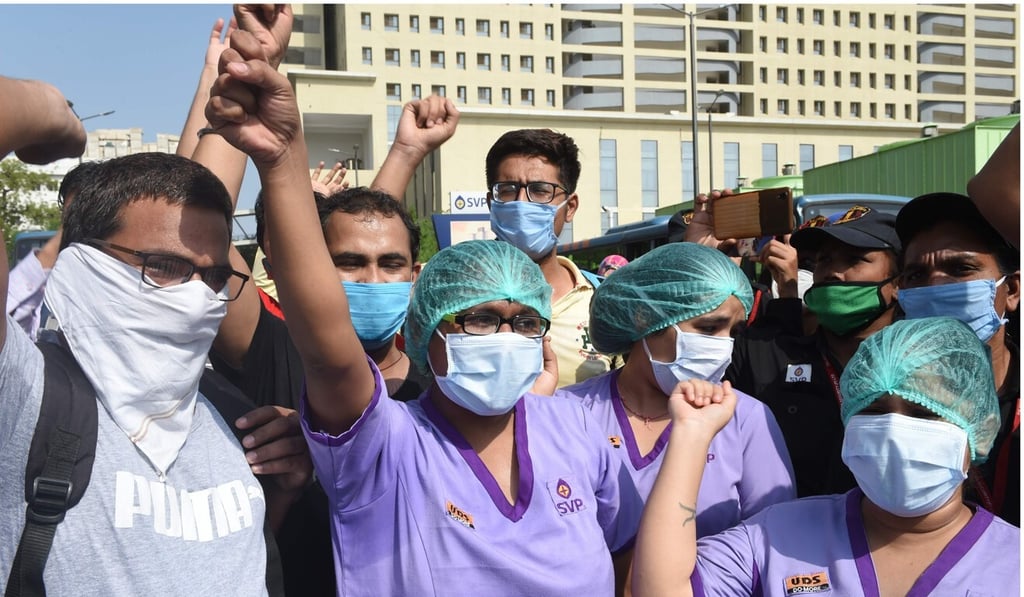
In Gujarat, there are just 0.33 hospital beds for 1,000 people, compared to the national average of 0.55 – which is already considered a poor standard.
Advertisement
“Gujarat has been spending less than one per cent on health, as a result of which the capacity of local health centres at the village and block levels/small towns/Mohalla clinics are very poorly equipped and poorly staffed. These are incapable of providing even minimum care to Covid-19 patients,” said Indira Hirway, director and professor of economics at the Centre for Development Alternatives in Ahmedabad.
Advertisement
Select Voice
Choose your listening speed
Get through articles 2x faster
1.25x
250 WPM
Slow
Average
Fast
1.25x