Advertisement
Myanmar
This Week in AsiaOpinion
Xu Peng

Asian Angle | How uneven borders fuel Myanmar’s vast and resilient scam economy

Fieldwork along the borders of China and Thailand reveals how uneven controls allow fraud networks to thrive despite crackdowns

Reading Time:3 minutes
Why you can trust SCMP
1
Advertisements for gambling sites and what appears to be Starlink satellite dishes on the roofs of buildings at the notorious KK Park complex in Myanmar’s eastern Myawaddy township, as pictured from Mae Sot district in Thailand’s border province of Tak, on September 17. Photo: AFP
Southeast Asia has become “ground zero” for the global online scamming industry, according to the UN, costing victims billions of US dollars each year. Scam operations are run by Chinese crime syndicates from fortified compounds in countries like Myanmar, which has been embroiled in a nationwide armed conflict since 2021.

The size of the scam industry has led to sustained security crackdowns in recent years. This has included a number of joint operations involving police forces from multiple countries. However, despite releasing tens of thousands of trafficked workers from these compounds, the raids have done little to wipe out scam operations.

In October, for example, Myanmar’s military stormed a major scam hub in southeastern Kayin State. The operation was, according to military spokesman Major General Zaw Min Tun, proof that the army would “completely eradicate online scam activities from their roots”. But, just days later, local reporting indicated that work was continuing uninterrupted at other compounds in the area.
Advertisement
Since 2018, I have been carrying out fieldwork along Myanmar’s borders with China and Thailand. I have found that checkpoint controls vary widely. This asymmetry determines where in Myanmar scam hubs emerge and helps explain why operations are often able to relocate rather than shut down when faced with pressure.
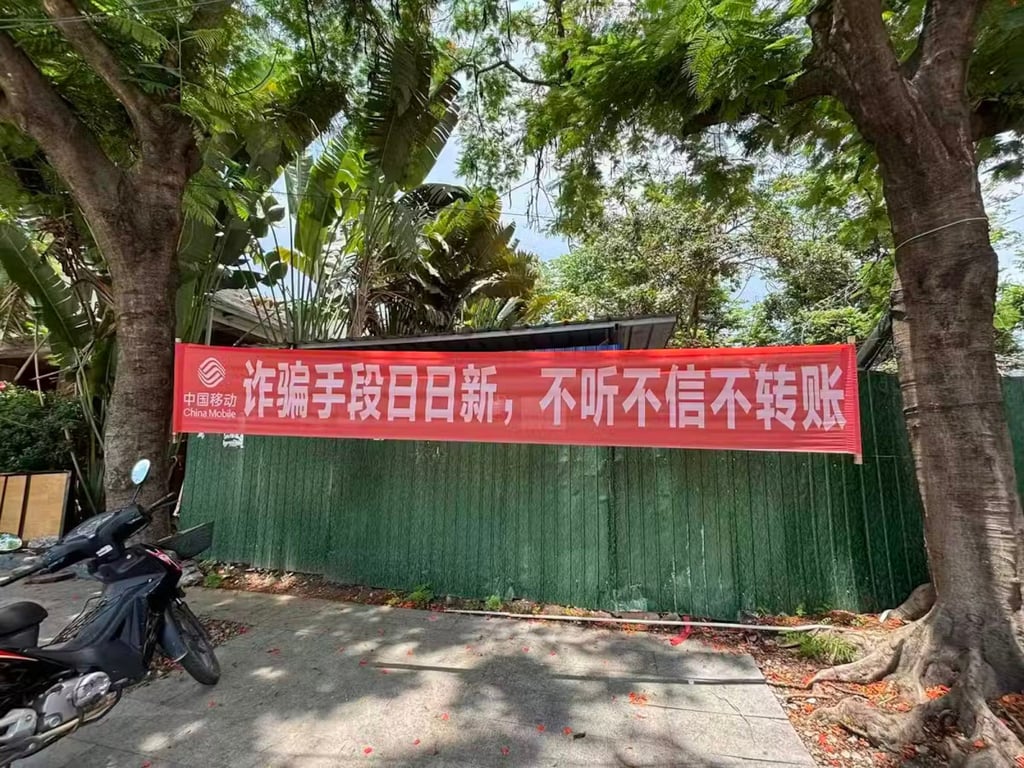
A banner warning against scams at Menglian border port in China’s Yunnan province. It reads: “Scam tactics change daily – don’t listen, don’t believe, don’t transfer”. Photo: Xu Peng

China’s border with northern Myanmar is heavily secured. Before travellers reach the border, they must pass internal checkpoints on the main roads that lead into the border counties of Yunnan province.

Advertisement
Advertisement
Select Voice
Choose your listening speed
Get through articles 2x faster
1.25x
250 WPM
Slow
Average
Fast
1.25x