As a Singaporean urban farming company in the land-scarce city state, Archisen found itself in need of more land, ready talent and lower costs of production that would allow it to access the local market.
The economic zone, the world’s first involving two countries, was officially launched a year ago, with Malaysian Prime Minister Anwar Ibrahim and his Singaporean counterpart Lawrence Wong agreeing to develop 11 focus industries including food security, aerospace, pharmaceuticals and electronics in the 3,571 sq km (1,379 square mile) zone, nearly five times the size of Singapore.
Advertisement
While the JS-SEZ has performed well in terms of attracting sizeable investment in the first year of its official launch amid a time of global uncertainty, experts note that improvements can still be made on coordination on the ground between the two countries’ systems for more seamless operations.
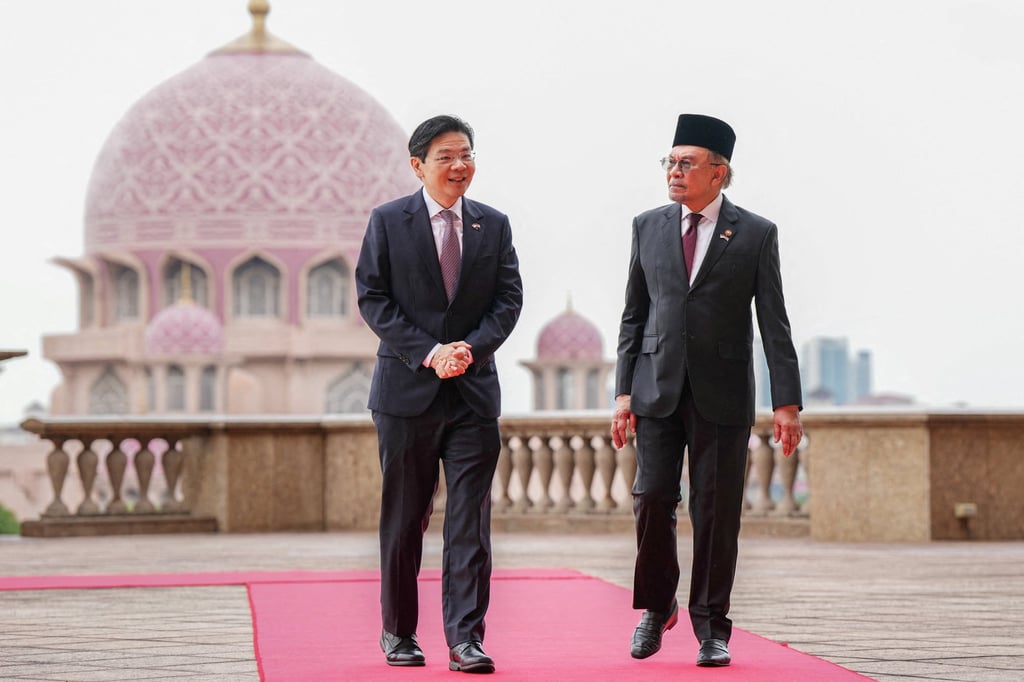
Singapore Prime Minister Lawrence Wong (left) and his Malaysian counterpart Anwar Ibrahim agreed to develop 11 focus industries in the Johor-Singapore Special Economic Zone. Photo: Reuters
Archisen is one of the first movers into a new flagship agrifood hub on the Johor side, the Southern Agropolis, which broke ground earlier this month. A recent Bloomberg report said the hub was expected to cost US$123 million and supply 10,000 tonnes of fresh produce a year.
Advertisement
“The JS-SEZ provided Archisen with an opportunity to expand into an area with available land, affordable costs of production, ready talent, and access to Singapore and Malaysia markets. It was generally smooth and both the Malaysian and Singapore governments were very supportive,” Wei told This Week in Asia.