Could AI algorithms hold China’s solution for global narrative on Tibet?
More than 300 media professionals, government officials and academics attend international communication-focused conference in Lhasa

To win the global war of words over Tibet, China’s western autonomous region that repeatedly makes international headlines, Beijing must stop fighting the West’s algorithms and start adapting to them.
That was the blunt assessment of Zachary Lundquist, an American media professional with the state-run China International Communications Group (CICG), speaking in Lhasa, capital of China’s Tibetan autonomous region, on Tuesday.
Lundquist – better known by his Chinese name, Huang Hao – was addressing an audience of more than 300 media professionals, government officials and academics at the Second Xizang International Communication Conference.
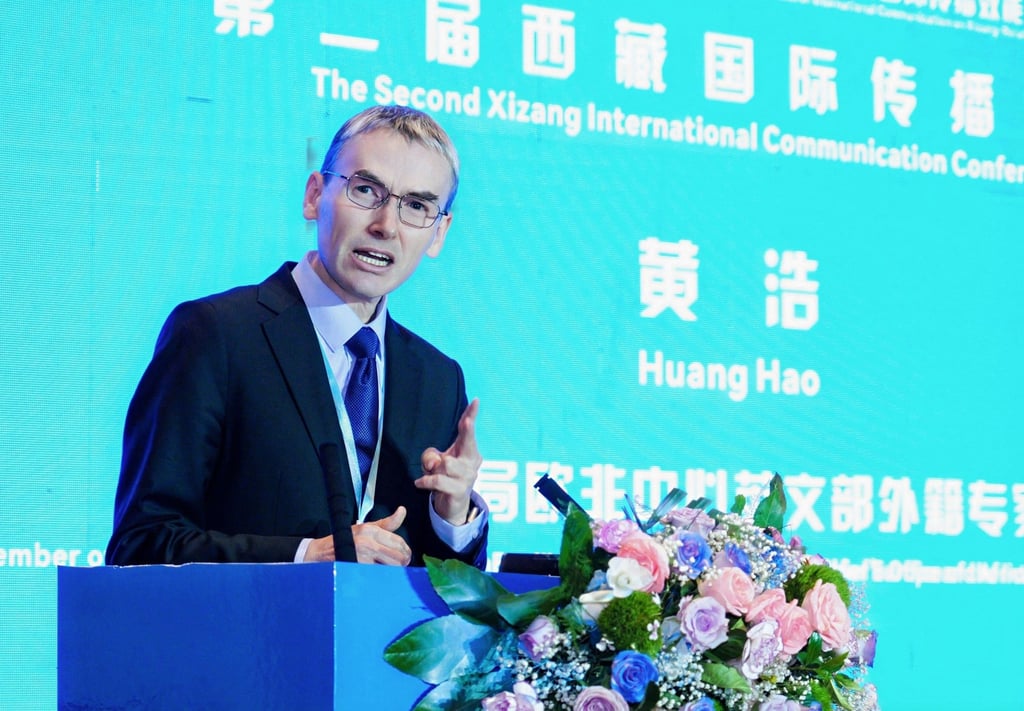
“It is not always born out of pure malice, but the algorithm ‘learns’ these associations over time,” Lundquist said, adding that this created an unbreakable information cocoon where rational voices were drowned out.