The stone age: how watchmakers like Rolex, Chopard and Biver have embraced the hardstone dials trend

Materials like tiger’s eye, onyx and obsidian are lending unique depth and character to watch designs by Van Cleef & Arpels and more
Within this broader revival, however, a subcategory has emerged. Dark hardstones such as tiger’s eye, obsidian, onyx and even meteorite are growing ever popular, absorbing light rather than reflecting it and offering a moodier, more tactile alternative to lacquered or sunburst finishes. As with any natural hardstone, each dial is inherently unique, a thin slice of the earth – or, in the case of meteorite, outer space – brought directly to the wrist.

Tiger’s eye, in particular, has become one of the most widely used hardstones for watch dials, prized for its unique banded surface. When cut into thin, polished slices, the stone reveals a silky, shifting glow that feels almost alive on the wrist, its tones moving between golden brown, deep chocolate and near-black as the light changes.
This optical effect, known as chatoyancy, is created by fibrous inclusions within the quartz-based stone, giving tiger’s eye its distinctive eye-like bands. With a hardness of seven on the Mohs scale, it is robust enough to be worked into ultra-thin sections without sacrificing durability. While the familiar yellow-brown variety remains the most common, rarer versions appear in red, blue-grey or green, each offering a subtly different mood when translated onto a dial.
Long before it appeared on watch dials, tiger’s eye held symbolic weight across cultures. In ancient Mesopotamia, it was known as Oculus Belus, meaning the eye of Belus, a name later associated with the Mesopotamian god Marduk. Roman soldiers wore it as a talisman, believed to offer protection and courage, while in the Middle Ages it was thought to repel spells and ward off the evil eye. Among various Indigenous American cultures, the stone was associated with protection and meditation, and in China it became linked to prosperity and positive energy.
The discovery of major deposits in South Africa in the 19th century briefly elevated tiger’s eye to precious stone status, before further finds across Africa and elsewhere led to its reclassification as semi-precious. Today, it is sourced from regions including South Africa, Australia, Brazil, the US, China, India and Madagascar.

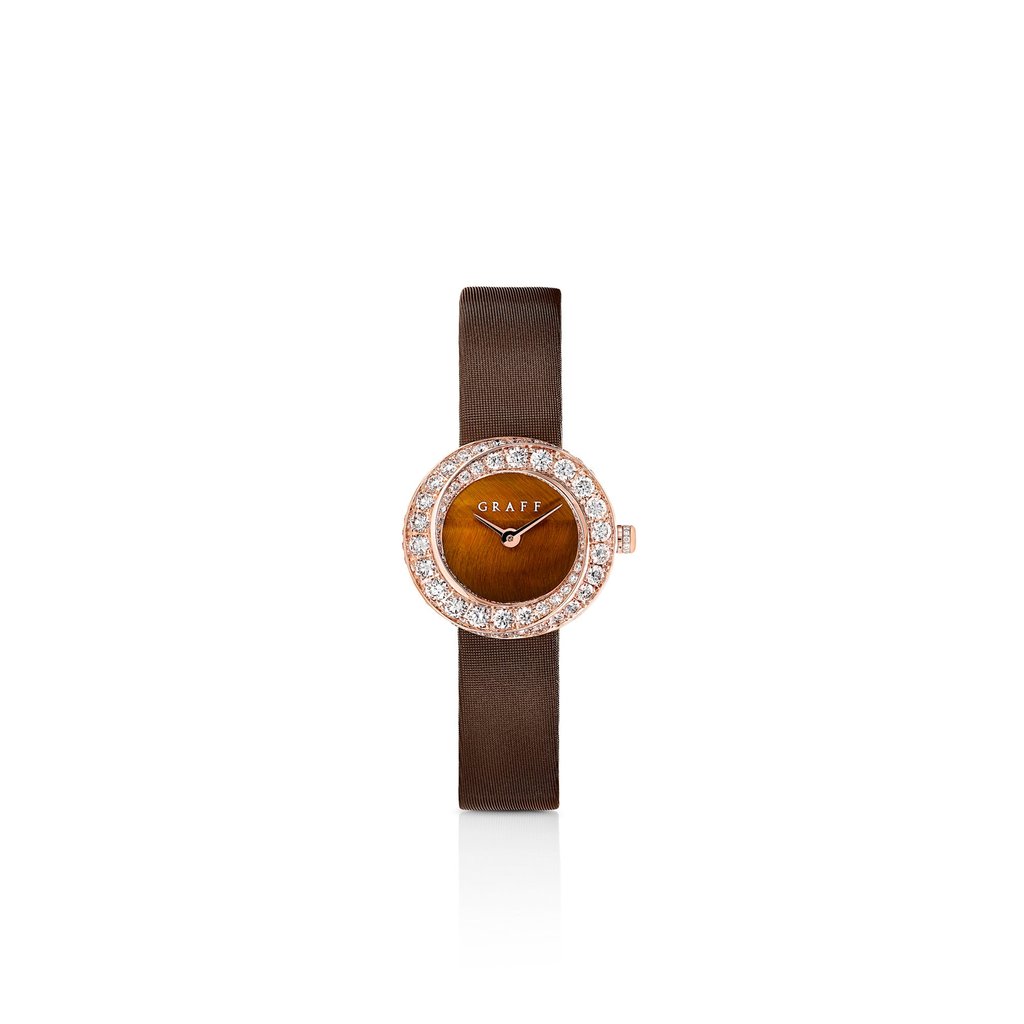
In contemporary watchmaking, tiger’s eye is prized for the movement and depth of its banded surface. Buccellati incorporates the stone into its Macri collection, where a tiger’s eye dial is set into a yellow gold cuff watch engraved using the maison’s traditional hand-engraving techniques and finished with white diamond accents. At Graff, tiger’s eye appears in its Spiral collection, with a golden-brown tiger’s eye dial set beneath a diamond-set rose gold bezel, the stone’s banded pattern echoing the whirl of diamonds that frames it.