Bruce Lee’s The Big Boss: the film that made a martial arts legend, even if everyone involved hated making it

Bruce Lee’s first Asian box office hit changed his life, but it wasn’t the easiest film to make – especially for the co-star who got killed off early to make way for the new tough guy in town
It’s nearly 50 years since Bruce Lee finally broke out as a star in The Big Boss. The Hong Kong martial arts legend was a child star with plenty of acting credits to his name, and his television portrayal of Kato, The Green Hornet’s assistant, in the 60s US action series was iconic. Yet it wasn’t until he finally got the lead in the The Big Boss that Lee established himself as an actor worthy of the highest billing.
Originally, Lee was not meant to be the star of the movie. When he signed with production studio Golden Harvest in June 1971, pre-production of the film – originally titled King of the Boxers – was already underway. James Tien, who had recently switched from Shaw Brothers to Golden Harvest, had already been earmarked as a future star and the lead actor for The Big Boss.
At this time, Lee was still in America. He had several projects he was trying to get off the ground – most notably The Silent Flute and Kung Fu. Although these two concepts would belatedly be green lit – without Lee’s involvement – in 1970 the prospects looked bleak. Lee was not keen to give up on Hollywood but he was struggling with money and a lack of work. It was in April that year when Golden Harvest supremo Raymond Chow first got in touch with Lee and talked to him about returning to Hong Kong to work on kung fu movies.
Neither side considered such an arrangement a priority. Lee wanted to remain in America and was wary of Chinese filmmakers and their perceived lack of professionalism compared to Hollywood. For his part, Chow was keener on luring wuxia star Cheng Pei-pei, the “Queen of Swords” and a friend of Lee’s in California, back to Hong Kong and hoped closer ties with Lee would help him accomplish this.
Eventually, both sides compromised. Lee accepted Chow’s contract despite it not containing the original terms he asked for, and Chow accepted he would only be getting Lee and not Cheng.
Lee agreed to fly to Asia and spend four months there making two movies. To prepare himself, he watched a number of Hong Kong kung fu flicks before flying, which were unimpressive. “They were awful,” he once said, adding that they seemed, “very superficial and one dimensional”.
When Lee arrived in Thailand, where The Big Boss was being shot, his opinion of things did not improve. Production was taking place in Pak Chong, a tiny village some 160km (100 miles) north of Bangkok. Lee wrote letters home to his wife, Linda, despairing of the situation: “The mosquitos are terrible and cockroaches are all over the place … The food is terrible, this village has no beef and very little chicken and pork. Am I glad I came with my vitamins … I miss you a lot but Pak Chong is no place for you and the children. It’s an absolute underdeveloped village and a big nothing.”
Lee’s feelings about his work on the film set were no more positive. “Who is this guy?” thought Zebra Pan, a stuntman unfamiliar with much of Lee’s prior work according to Matthew Polly in his biography Bruce Lee: A Life. Many of the crew were pals of James Tien and were suspicious of Lee’s arrival, fearing – correctly – that this man from Hollywood would upstage their friend.
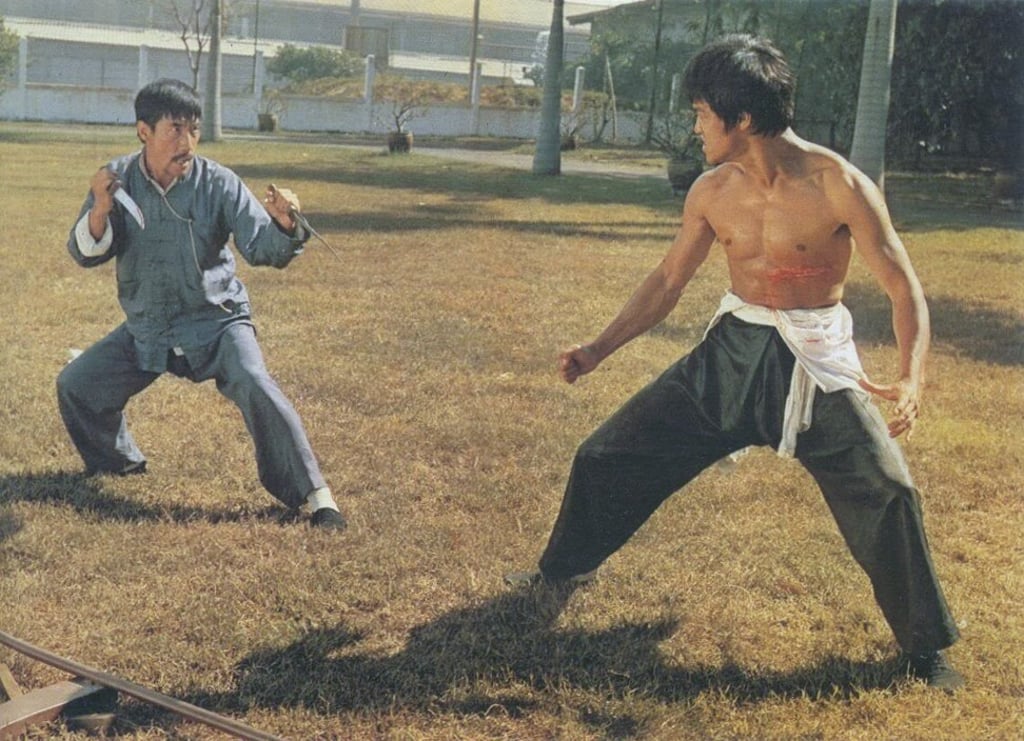
One of the biggest sources of disagreement on set was the nature of the action scenes. Kung fu movies up to this point had been based on the traditions of Cantonese opera with its intricate, flowing sequences and wide variety of moves. Lee, however, had never studied that tradition. He was more a rough and ready street fighter. What Lee wanted to put on film was a quicker, snappier, more realistic style of fighting.
This put Lee on a collision course with the film’s original director, Wu Chia-hsiang, who preferred to adhere to strict tradition and what he knew best. The two butted heads and both complained to Raymond Chow back at Golden Harvest.
“You’ve been swindled,” Wu complained to Chow. “You told me this guy was very good, but he can’t fight. All he knows are three kicks. I call him ‘Three Leg Lee’.”