
Reflections | The stories of Ganjiang and Moye, ancient China’s celebrated swords and their makers
- Ancient China was home to many famous swords, among them were Ganjiang and Moye, named after the married couple that made them
- Legend and mythology collide in two tales of how the pair of swords came to be, neither of which is short on drama

I have been looking for, without success, a qualified restorer to repair an antique keris, a short sword with a distinctive wavy blade that is indigenous to many parts of Southeast Asia. According to family lore, the keris was conferred on one of my male ancestors by a sultan of Terengganu, a state on the east coast of the Malay Peninsula where my paternal relatives have lived and thrived for possibly three centuries.
The veracity of the story notwithstanding, it is a beautiful work of art, a family heirloom that I am holding in trust for my nephew, to whom I shall bequeath it at an appropriate time. In the meantime, I would very much like to fix the wooden scabbard, the top of which had been detached, and if possible, clean the blade to reveal the etched patterns that have been obscured by unknown years of oxidation.
Ancient China was home to many famous swords, whose origins and odysseys are shrouded in myths and legends. Among the most celebrated swords were Ganjiang and Moye, named after a married couple who were also their makers. Moye’s father Ouyezi was also a master swordsmith, and is venerated as the pioneer of Chinese sword-making.
There are two versions to the story of Ganjiang and Moye. In one, the couple live in the state of Wu, located in the lower reaches of the Yangtze River. Helü, the king of Wu who reigned from 514 to 496BC, orders Ganjiang to forge a sword with a blade of unmeltable iron. Moye asks him what could be done, and he recounts how Ouyezi had sacrificed a woman to facilitate the process. On hearing this, Moye throws herself into the furnace and the iron ore liquefies at once. The result was two swords named Ganjiang and Moye.
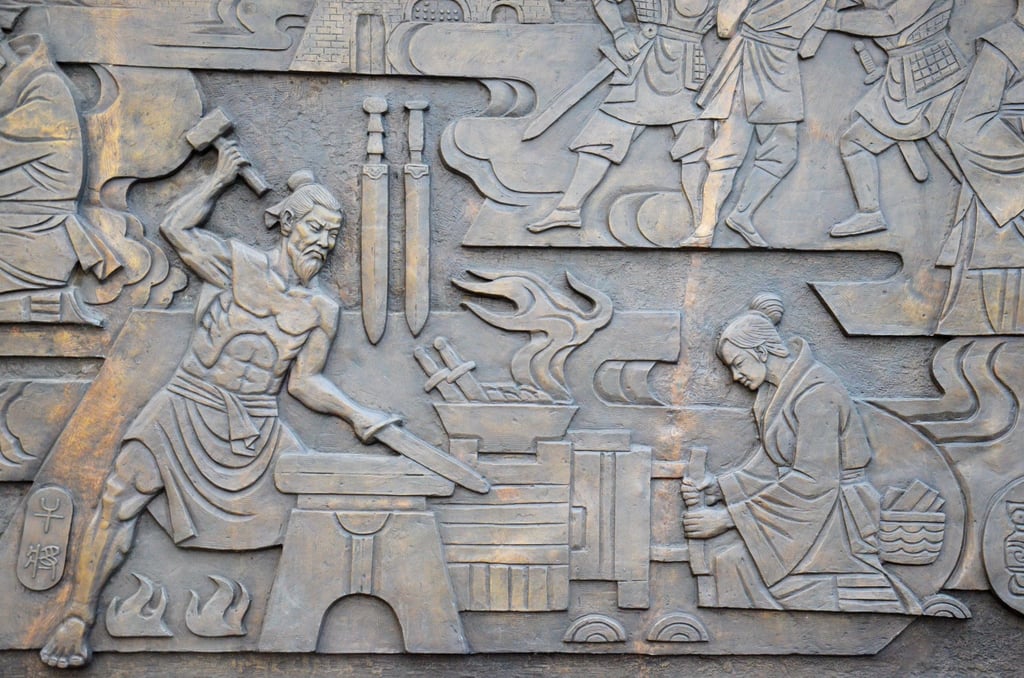
The other version plants Ganjiang and Moye in the neighbouring state of Chu, where Ganjiang spent three years forging a pair of swords for the king of Chu, but hides one away. Before he is executed for deceiving the king, he tells the pregnant Moye the location of the hidden sword. Moye gives birth to a son, Chi, who retrieves the sword and vows to avenge his father’s death.