The first Chinese-built railway, the enthusiast trying to save it and his hero, the ‘father of China’s railroad’
As China forges ahead with a high-speed rail network few can rival, it seems hard to imagine it took 21 years for suspicious Qing dynasty officials to approve its first domestically built railway. An enthusiast tells of his fight to preserve it

It’s a little after 6am when the sun rises over Changping, a nondescript district in the northwest of the expansive Chinese capital. Flanked by the Mangshan hills, which form a natural limit to Beijing’s urban sprawl, Changping North railway station is small and devoid of distractions. With no cafeteria or convenience store in which to kill time, I settle myself in the spartan waiting room and stare at the clock. Most of my fellow travellers are asleep or fiddling with their smartphones.
Eventually, a green train with a yellow stripe along its flank – No 1458, from Changping North to Zhangjiakou South – slides into the station. I board, find my third-class seat and wait for the engine to shudder back to life. We depart at 6.46am, navigating the last tumbledown extremities of the city before concrete is replaced by jagged hills and steep ravines.
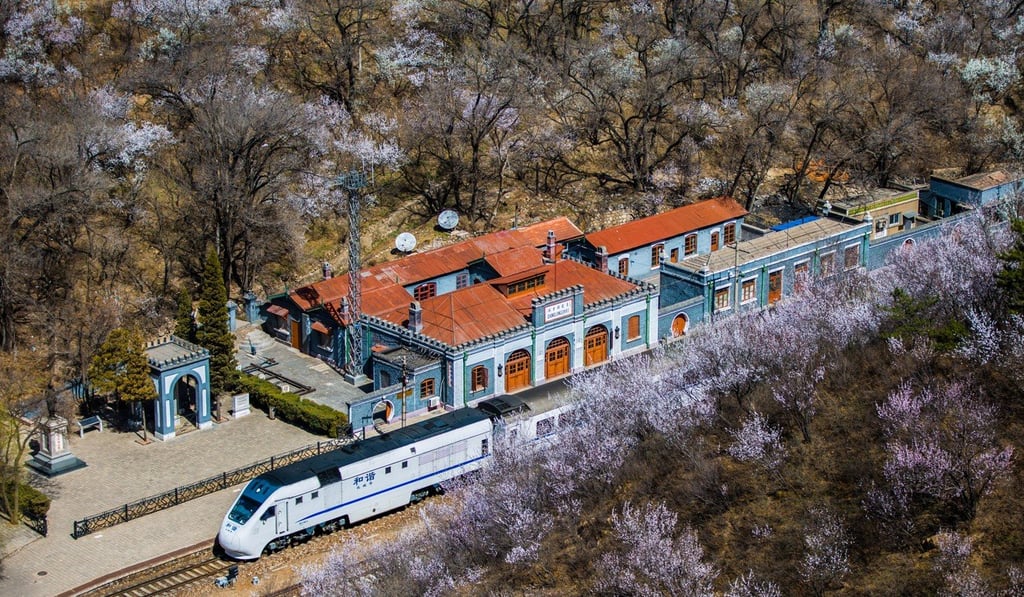
As the red East Wind locomotive hauls the train towards the Badaling section of the Great Wall, we pass old stations – many no longer in use, and all crumbling testimony to the longevity of this particular line. It’s impressive to be on a train negotiating such dramatic topography. Knowing that the line was completed in 1909, and that it was the first of its kind, designed and built solely by Chinese hands, makes the journey extra special.
After reversing the direction of travel twice – a technique known as zigzagging, and employed to negotiate steep gradients – the track eventually leaves the mountains for a vast plain that is coloured 50 shades of brown. This is a land of pig farms, of grazing goats and horses and of single-storey brick compounds with gardens littered with plastic rubbish. On this side of the Great Wall, the “Chinese dream” is largely an abstract concept.