The breasts: from nipples and implants to cancer, everything you need to know – and a few things you don’t
- Humans are also the only species to stimulate female breasts during sex, while no woman has a perfectly symmetrical bust
- In the Asia-Pacific region, China dominated the breast implant market in 2019, accounting for over 30 per cent, followed by Japan

Breasts – or mammary glands – are a defining feature of animals which give birth to, and feed, live young, but humans are unique in identifying breasts as sexual.
French king Louis XV is rumoured to have declared, “And her breasts? That’s the first thing one looks at in a woman.” A 2011 study published in Archives of Sexual Behaviour, based on research conducted at the Victoria University of Wellington in New Zealand, lends credence to the king’s observation, saying that breasts are often the first thing men look at when they see a woman, and for a longer time than other body parts.
No two pairs of female breasts are alike, nor are the two in one pair the same. No woman has a perfectly symmetrical bust: the breasts may vary in size, one might sit slightly higher, or be more round or pert than the other. The differences are perfectly normal.
Breasts are composed almost entirely of fat – they contain no muscle – and are built of a series of lobes arranged like the petals of a flower. Within each lobe are smaller parts known as lobules, and the whole arrangement is linked by milk-producing ducts which lead to the nipple in the centre of the areola, the brown bit in the middle from which a baby suckles.
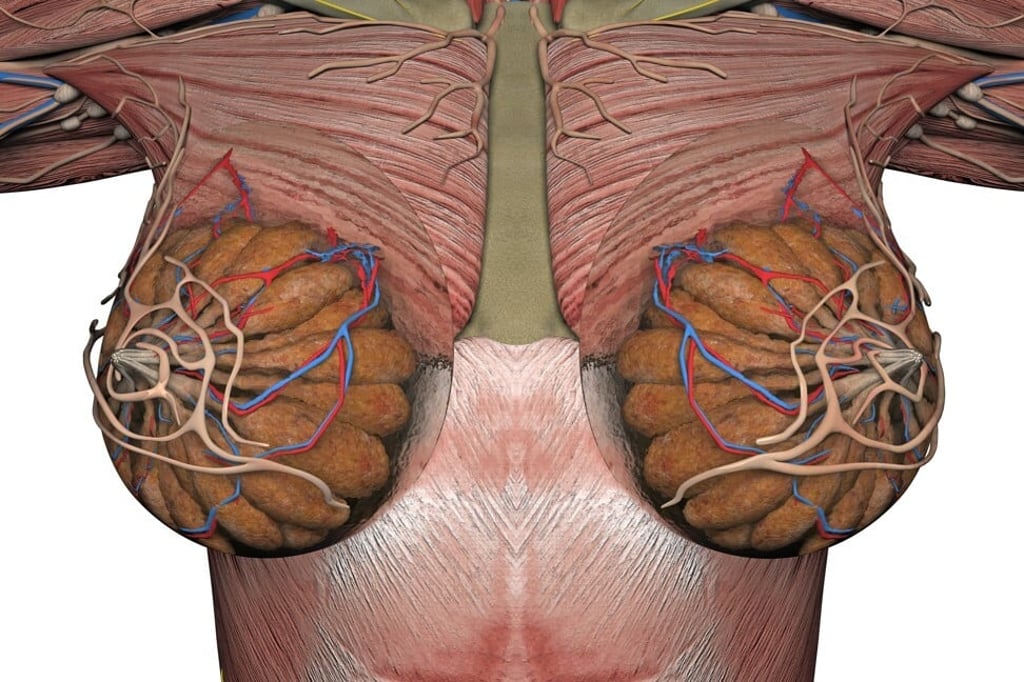
Women are the only female mammals whose breasts begin to grow at puberty and remain enlarged, independent of pregnancy, and whose breasts retain a fullness after pregnancy and nursing. Humans are also the only species to stimulate female breasts during sex.