Advertisement

Chinese shipyards shift focus to advanced vessels as South Korean rivals gain ground

Chinese shipbuilders accounted for 65 per cent of global orders in the first three quarters, down from nearly 75 per cent a year earlier

Reading Time:3 minutes
Why you can trust SCMP
A model of China’s polar research icebreaker Xuelong 2, or Snow Dragon 2, is displayed at the Marintec China exhibition at the Shanghai New International Expo Centre in Shanghai. Photo: Xinhua
Daniel Renin Shanghai
Chinese shipyards, facing a drop in orders, plan to divert more capacity towards new-energy and advanced vessels to maintain profitability as they face mounting challenges from South Korean counterparts, industry officials say.
The country’s shipbuilding firms, from gargantuan state-owned China State Ship­building Corp (CSSC) to privately owned shipyards, held 65 per cent of global orders in deadweight tonnage terms during the first three quarters of 2025, compared with about 75 per cent a year earlier, according to shipping services provider Clarksons.

Geopolitical tensions resulted in a plunge in orders for Chinese-made vessels this year, which stood at 10.5 million tonnes in the three months to September, down 61 per cent from 26.9 million tonnes a year earlier, Clarksons reported.

Advertisement

“The world economy and shipbuilding industry have entered a new cycle where growth will slow and uncertainties will increase,” said Xing Wenhua, chairman of the Shanghai Society of Naval Architects and Marine Engineers. “China’s shipyards have displayed their resilience and are playing a role in stabilising the global [shipbuilding] supply chain.”
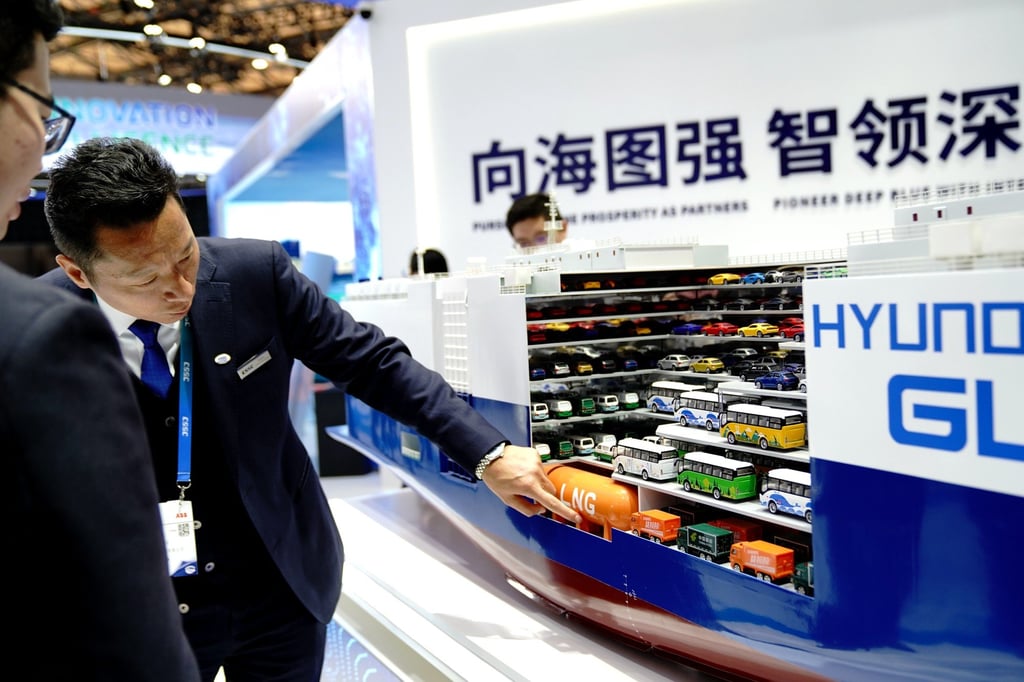
A model of a South Korean car carrier is displayed at the Marintec China exhibition in Shanghai. Photo: Xinhua
Earlier this year, the US threatened to slap port fees on Chinese vessels amid an escalating trade war between the world’s two largest economies. In October, the Trump administration slapped a levy of US$50 per net tonne on Chinese vessels before Beijing retaliated with a 400 yuan (US$57) per net tonne charge for US ships.
Advertisement

Beijing and Washington agreed to drop the punitive fees after they reached a truce in the trade war at the end of October.

Advertisement
Select Voice
Choose your listening speed
Get through articles 2x faster
1.25x
250 WPM
Slow
Average
Fast
1.25x