‘My life is not your porn’: South Korean women fight back against hidden-camera sex crimes
Fury over sexual harassment has fuelled the casting aside of entrenched gender inequality as women speak out against discrimination

The movement has spread so far that even teenagers and junior-school students have begun to find their voices. In recent months, #School_MeToo has been trending on social media, as students have begun to call out sexual harassment and assault in schools – as well as the patriarchal culture evinced by a male teacher at a girls’ school in Busan, who was reported by his students for saying women were “asking to be raped” if they went drinking at night.
To the outside observer, such movements may seem like a natural reaction to oppression. But for many women in a nation that ranks 118th out of 144 countries in terms of gender equality according to the World Economic Forum, it signals an unprecedented change in social norms. The inequality South Korean women have faced – and remained mostly silent about – includes having to follow fixed gender norms at home, institutionalised discrimination and sexual harassment at work, and spycam technology that compromises their safety and privacy.
“Patriarchal culture is just so deeply rooted and pervasive that women experience gender discrimination on all levels, starting with the family,” said a Seoul woman, who asked not to be named. “For example, some girls weren’t allowed to study further because they had to earn money to support their younger brothers. These are the horror stories you hear from [older women].”
Gender equality divides the generations in South Korea. “My mom went to medical school where they had a quota for women,” the woman said. “She was one of the top students, but when she walked up to podium to receive her scholarship, another woman in the audience yelled ‘B***h, you stole a spot from my son.’”
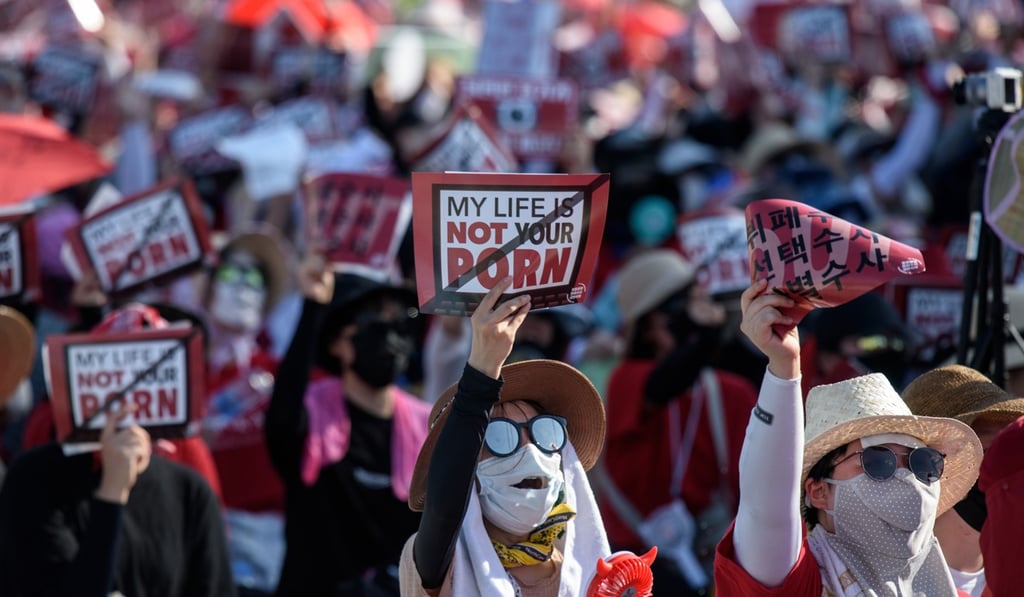
Unfortunately, the same technological sophistication and online communities are still being used by male detractors of feminism and gender equality to continue objectifying and vilifying women.